


Mercedes-Benz Safety
Luxury through peace of mind.
Safety is a core component of Mercedes-Benz’s DNA. Mercedes-Benz is regarded as the inventor of modern vehicle safety – and remains a pioneer in the field to this day. Here are some of the most advanced and historic safety features in the Mercedes‑Benz lineup.
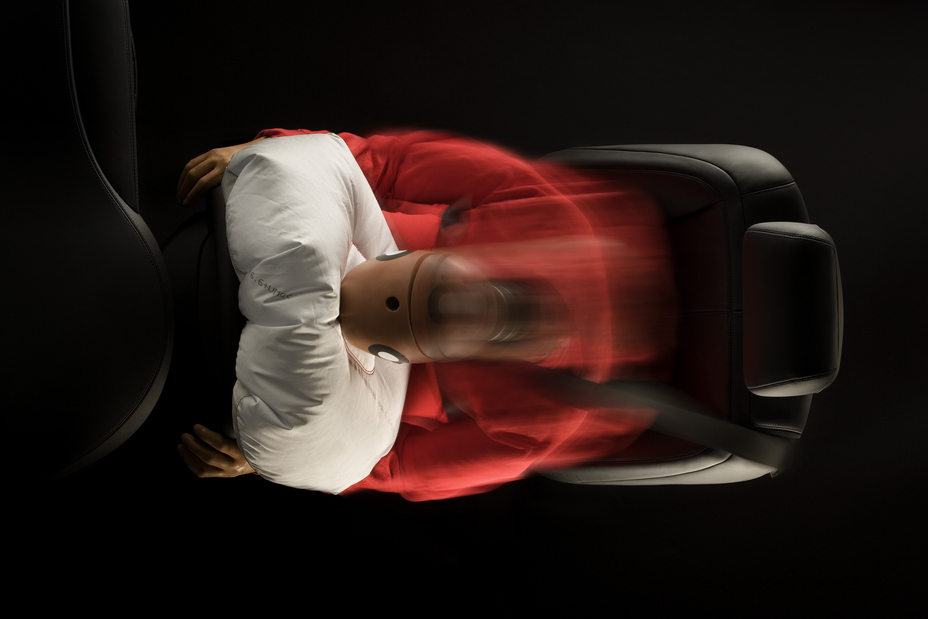
The Airbag
Mercedes patented the airbag concept in 1971 and introduced it as an option in the S-Class in 1981 (with belt tensioner). They expanded it with side, curtain, knee, and even belt-integrated airbags for comprehensive occupant protection.
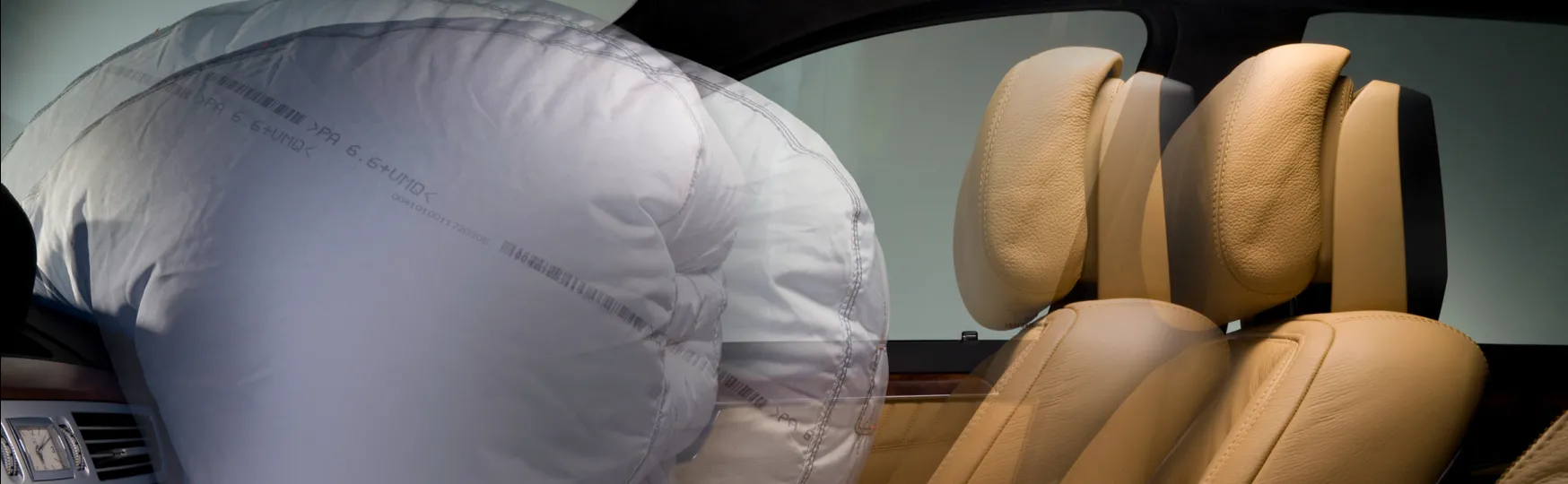
PRE-SAFE®
Mercedes-Benz patented PRE-SAFE system anticipates a collision using a network of sensors. Seatbelts tighten, headrests adjust, and windows close all in a matter of seconds. Newer vehicles even emit pink noise, triggering the inner ear to protect your hearing from the pressure of impact.
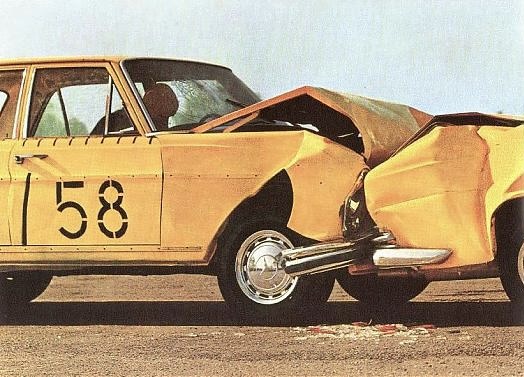
Crumple Zones
Patented by engineer Béla Barényi in 1951 and first implemented in production models (like the "Fintail" W111 in 1959), this design absorbs crash energy through deformable front and rear sections while keeping the passenger cell rigid—fundamentally changing passive safety worldwide.
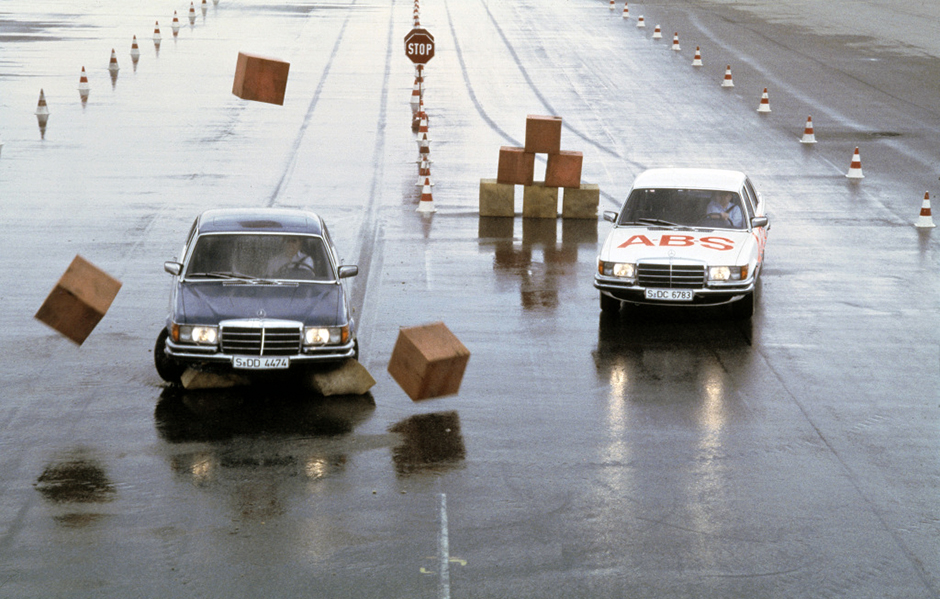
ABS (Anti-lock Braking System)
Mercedes brought the modern electronic ABS to production in 1978, preventing wheel lockup during hard braking to maintain steering control—now mandatory on vehicles globally.
Active Distance Assist DISTRONIC®
Safe driving means keeping a proper distance. Active Distance Assist DISTRONIC® keeps a selectable set of car lengths between you and the vehicle ahead. As traffic slows or stops, so does your Mercedes-Benz, acting as a second set of hands.
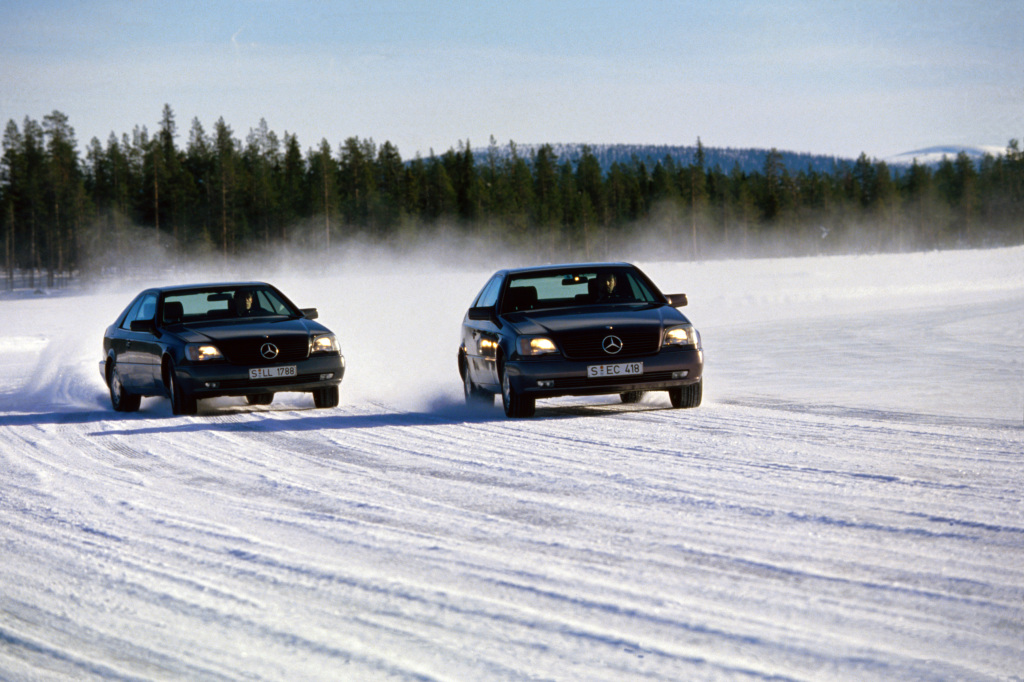
ESP® (Electronic Stability Program)
Introduced in the S-Class, this system helps prevent skids by automatically braking individual wheels and reducing engine power. It's considered one of the most important safety breakthroughs since airbags and is now required by law in many regions.
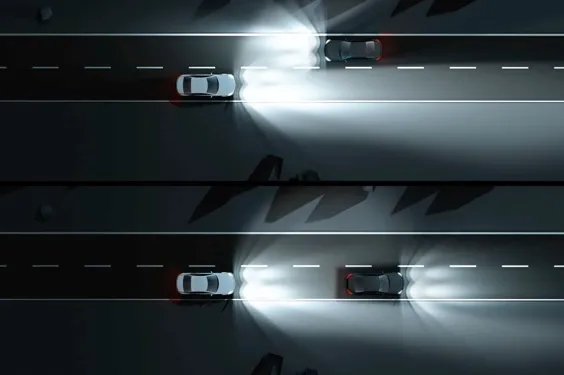
Adaptive Highbeam Assist
Adaptive Highbeam Assist uses a dedicated camera to scan the road ahead for the lights of other vehicles. Based on their position, it varies the headlamps to maximize illumination without causing glare for other drivers.
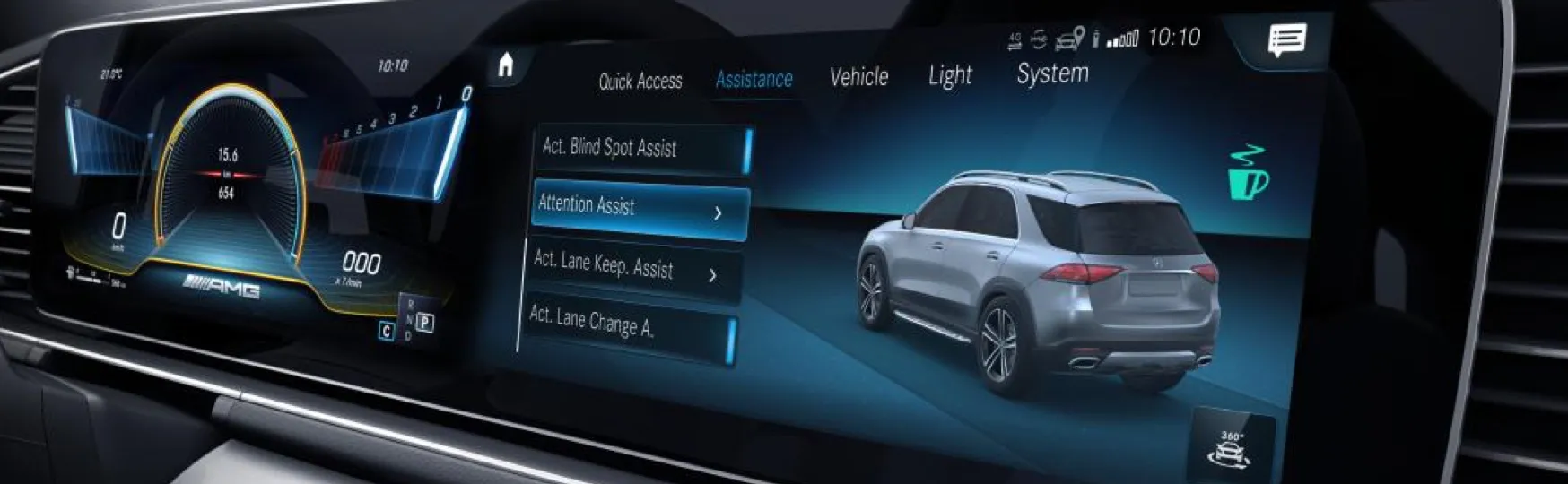
ATTENTION ASSIST®
Even in a Mercedes-Benz, long drives can result in fatigue. ATTENTION ASSIST monitors your interaction with the vehicle controls and detects steering corrections that suggest drowsiness. If it senses driver fatigue, it triggers an alert that encourages you to stop for a rest.
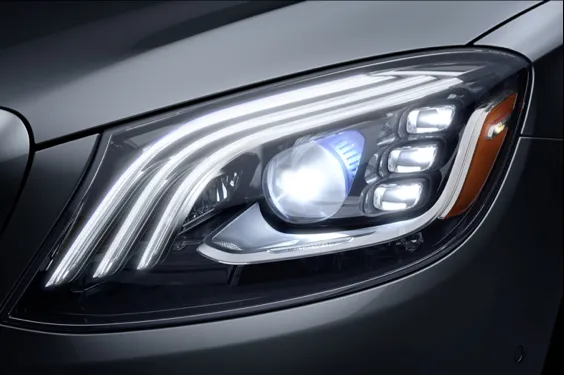
LED Intelligent Light System
Numerous light-emitting diodes (LEDs) per headlamp generate an output that’s the closest yet to how humans perceive natural daylight. The direction and distance of the beam shifts based on your steering, speed and surrounding traffic.

Protecting what matters most.
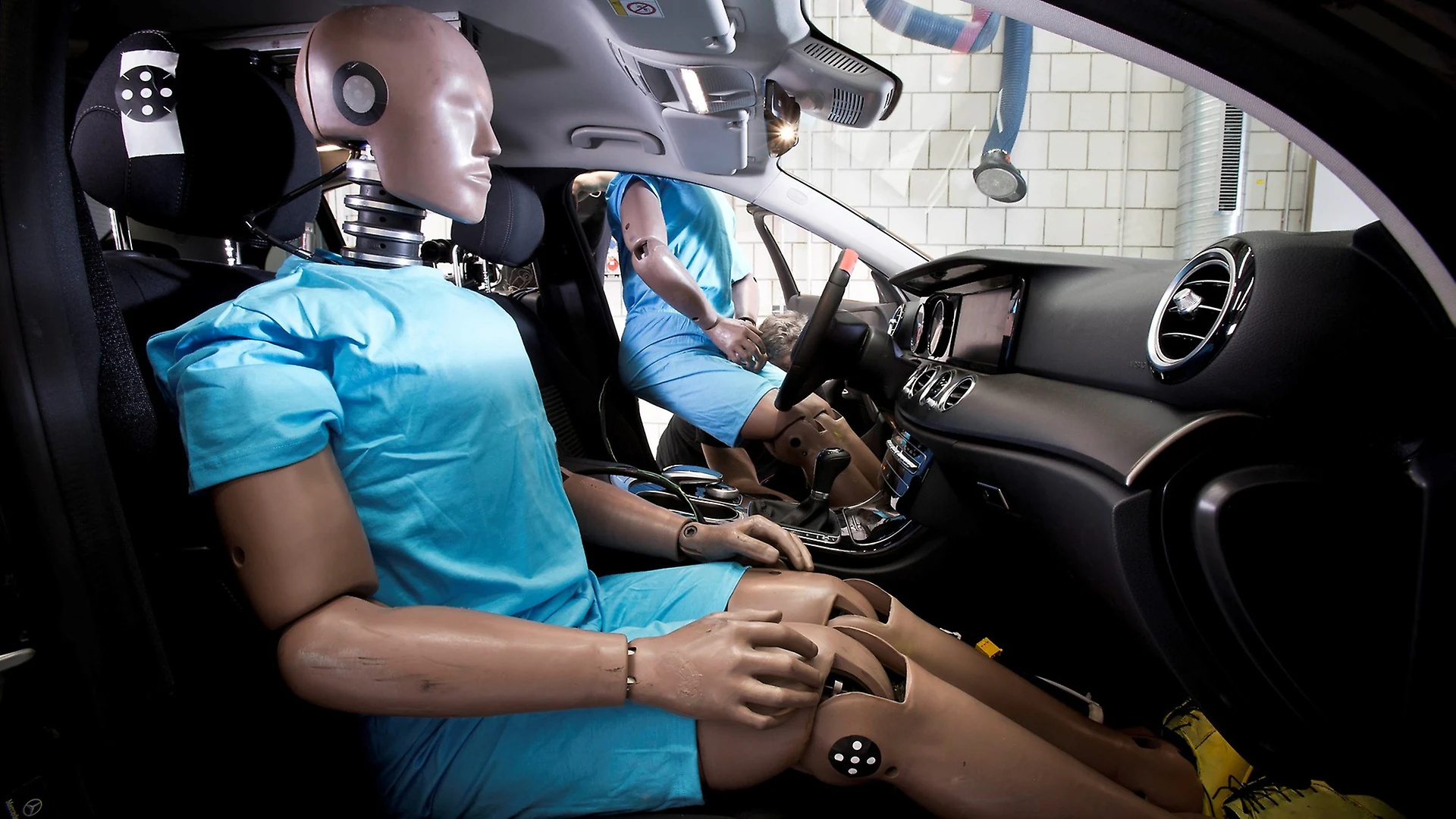
An accident occurs. Various crumple zones keep the cabin isolated, while an advanced airbag system offers protection to the head, knees and more. Side impact airbags deploy in the rear, and even the seatbelts themselves are reinforced with airbags to distribute force and protect the ribcage.
Protecting drivers and passengers has always been Mercedes-Benz's priority, and with every innovation, that legacy continues.
Impact Stories: Real people, up close and personal.
Drivers and their families tell unscripted stories of survival – what they saw, what they felt, and how it changed their perspective for good.
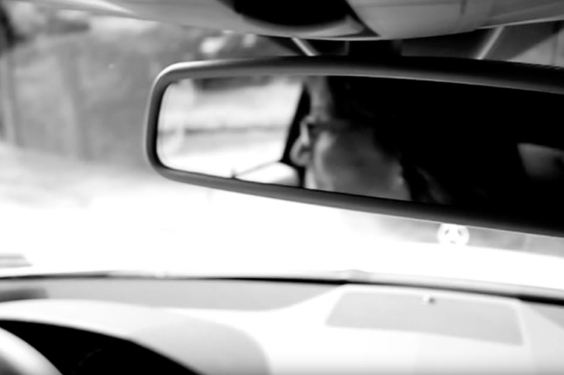
Surviving a Head-On Collision
Deborah and Steve rounded the corner – just as they’d done a million times before. This time, an SUV was headed right at them, and the front-end safety design of their Mercedes-Benz was there when they needed it.
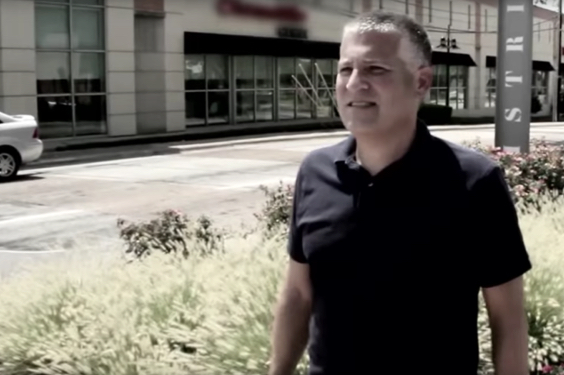
Withstanding a Hit from Behind
See the story of Joe and his fiancé, how the car behind them was fast approaching, and how Mercedes-Benz technology helped them get through it.

Encounter with a Pick-Up
Hear Angela relive the day that her car slammed into the back of a pick-up truck on the opposite side of the street. The truck went airborne, and her Mercedes-Benz took the hit.
Dragged by an 18-Wheeler
Everything can change in a matter of moments, like when the Favaro family was hit and dragged by an 18-wheeler. Luckily for them, their Mercedes-Benz safety system came to their defense.
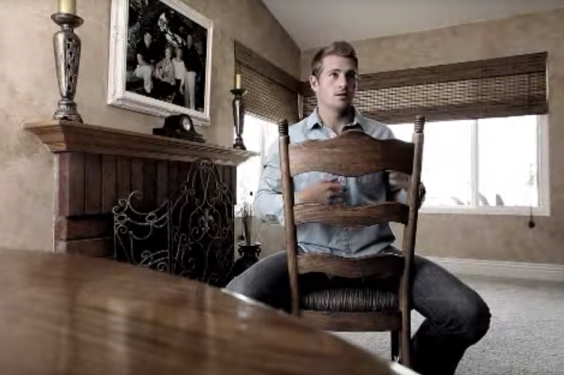
Playing The “What If” Game
Witness the survival story of a star athlete who might have never played again if it wasn’t for the protection of his Mercedes-Benz.

A Baby Named “Crash”
When a pregnant woman and her husband are involved in an accident, their future flashes before their eyes. See how they survived – and thrived – thanks to the safety of their Mercedes-Benz.

Accident Investigation
Just a few pieces of data can mean the difference between a collision and close call. That's why Mercedes-Benz created the Mercedes-Benz Accident Investigation team, a special unit in Stuttgart, Germany dedicated to gathering and evaluating information that has the potential to save lives across the world.
From impact speed to collision angles, the data collected at the scene informs the ongoing improvement of safety features, and has led to the development of groundbreaking technology like ATTENTION ASSIST and DISTRONIC PLUS with PRE-SAFE® Brake.

Technology centre for vehicle safety
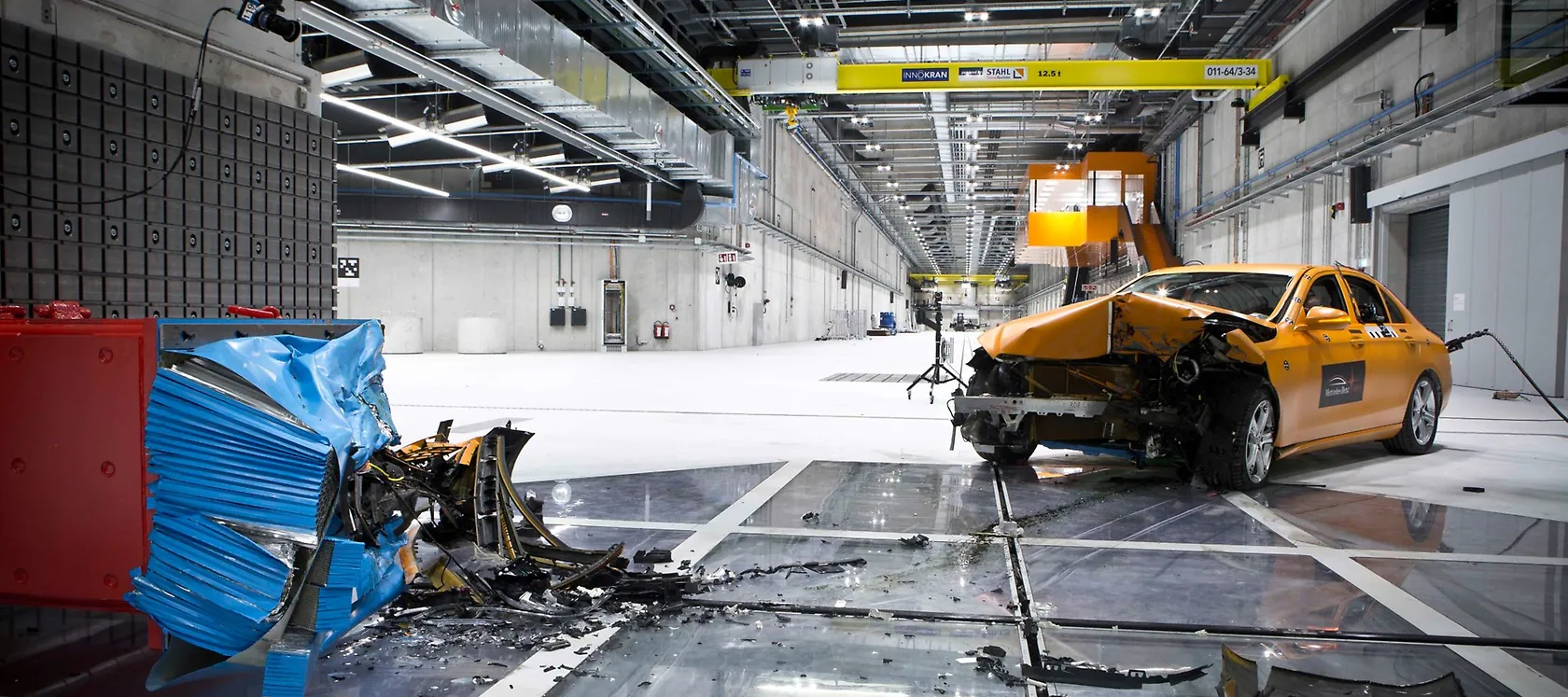
Mercedes-Benz has the world's most sophisticated crash test centre with the technology centre for vehicle safety (TFS) in Sindelfingen. The building, with its numerous test facilities, opens up completely new possibilities, e.g. for vehicle-to-vehicle tests, the configuration of assistance systems and PRE-SAFE®, and for the verification of vehicle concepts using alternative drive systems. A few facts and figures about the crash test centre:

Possible crash configurations:
There are around 70 different configurations for cars and trucks, incl. frontal crash (with varying degrees of overlap), rear impact, side impact with movable barriers and lateral post impact, rollover test and vehicle-to-vehicle crash.
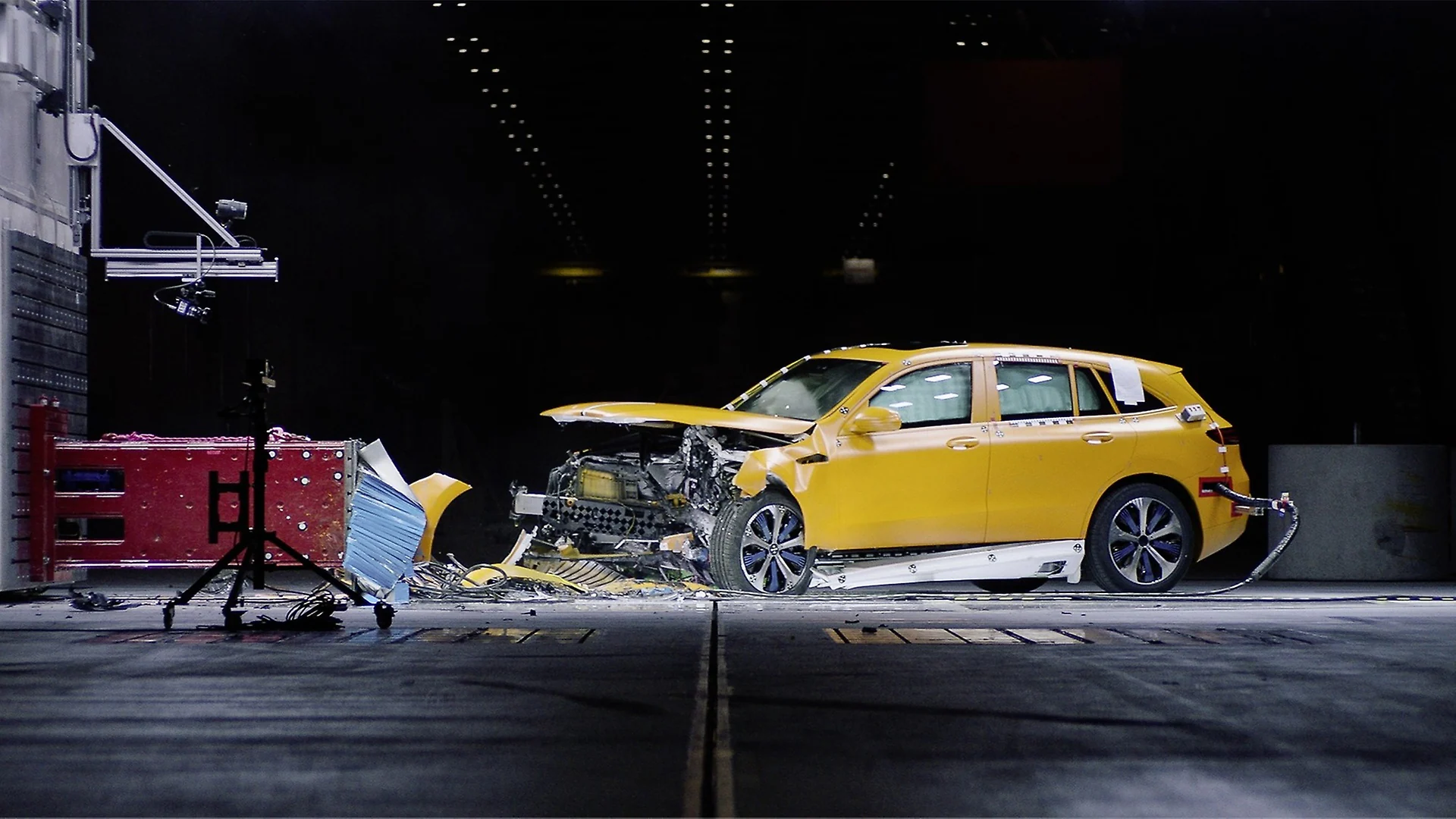
Documentation:
The crashs are documented by using high-speed cameras (up to 1000 images per second), also from below (glass-covered filming pits).
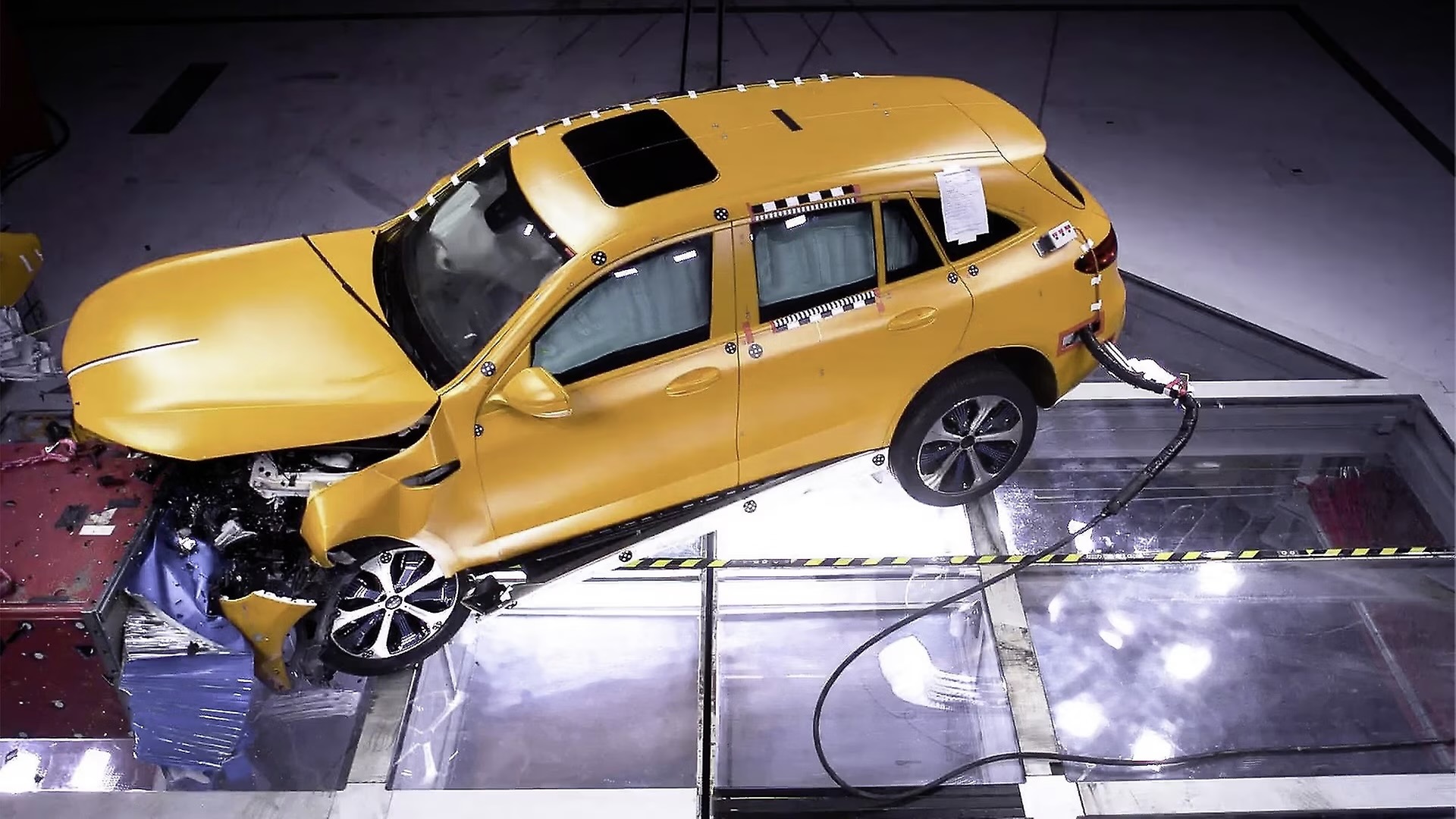
The side markings along the crash tracks, which look like a QR code, are there to provide orientation to a drone:
The drone flies along the track before a crash to make sure that there are no longer any personnel there.
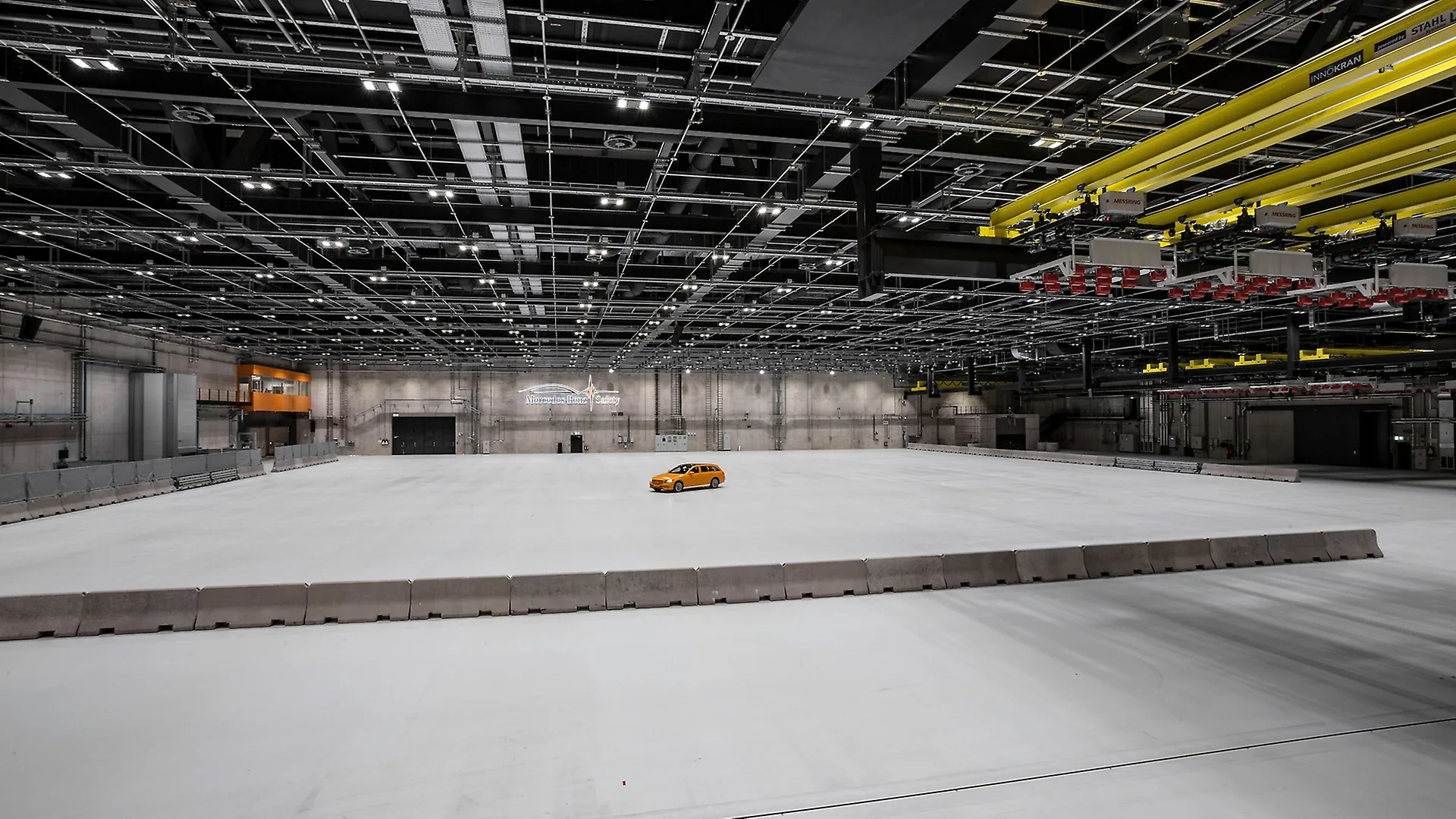
Each of the five large cross-members in the unsupported area of the crash hall weighs around 210 tonnes:
They allow an obstacle-free area of 90 m x 90 m.
The temperature on the day had to be taken into account when installing these steel cross-members:
This was very important owing to thermal expansion of the steel.
The pits at the collision points of the crash tracks have a depth of five metres:
They house modern high-speed cameras which film the impact from below. Thanks to the compact Microtrack system, the guide rails for the vehicles are much narrower than before (70 mm rather than 180 mm in the old system). This means that unlike before, almost the entire underbody of the vehicle can be filmed.
The glass panels covering the pits are eleven centimetres thick:
They can withstand the weight of trucks, which can now be tested in an enclosed hall for the first time.
"Ants" are an important working aid in the TFS:
The three-wheeled electric scooters with which personnel in the crash centre can cover the long distances are known as "Ants". They are capable of up to 22 km/h. An additional luggage carrier allows items weighing up to 50 kg to be carried as well.
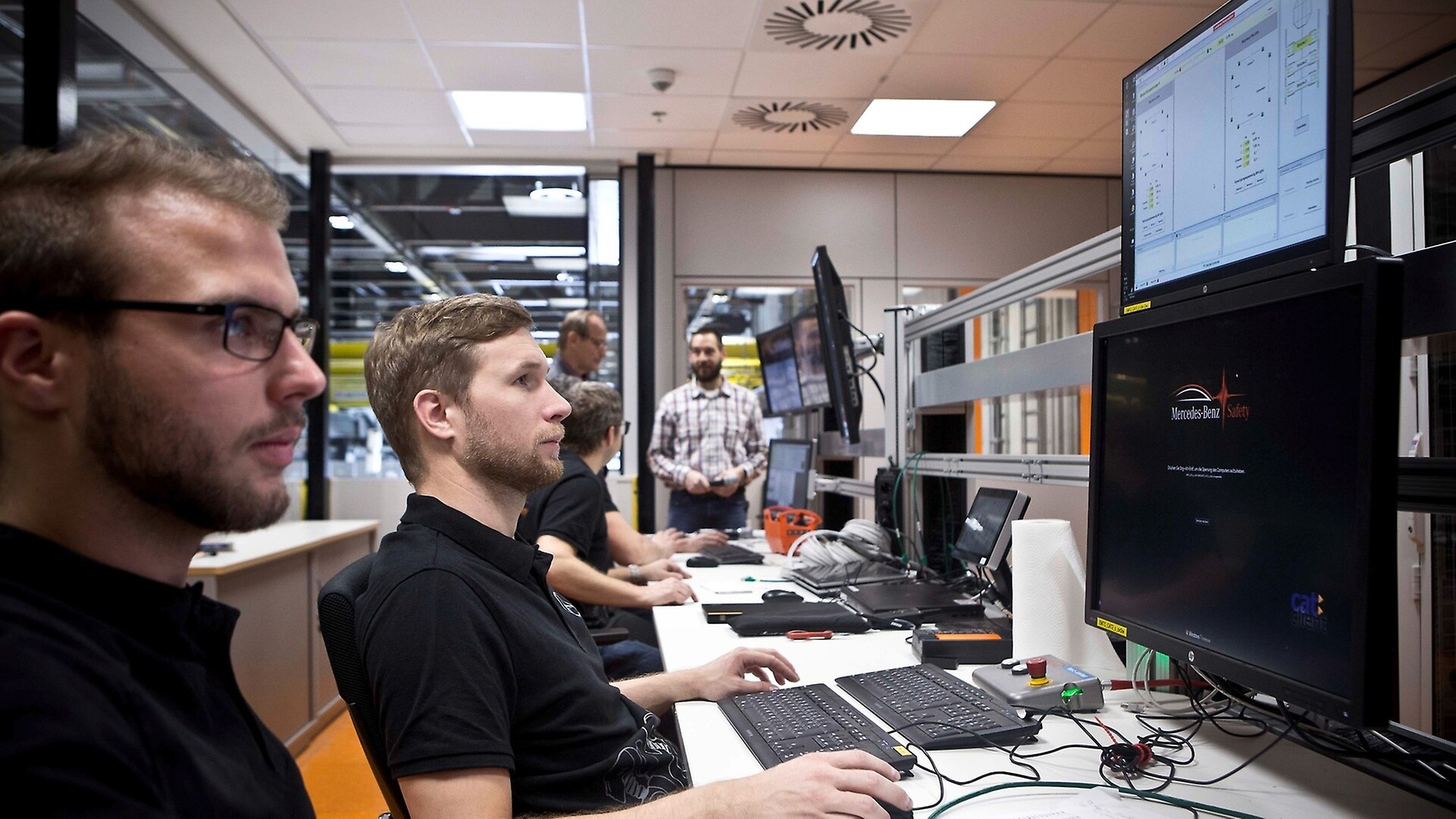
Reinforced bodyshells can be reused several times for sled tests:
In this crash simulation a test sled is accelerated and braked. A test object (vehicle bodyshell or assembly) is mounted on the sled and subjected to the forces arising during a real vehicle crash. These sled tests allow non-destructive testing of individual components, especially restraint systems.
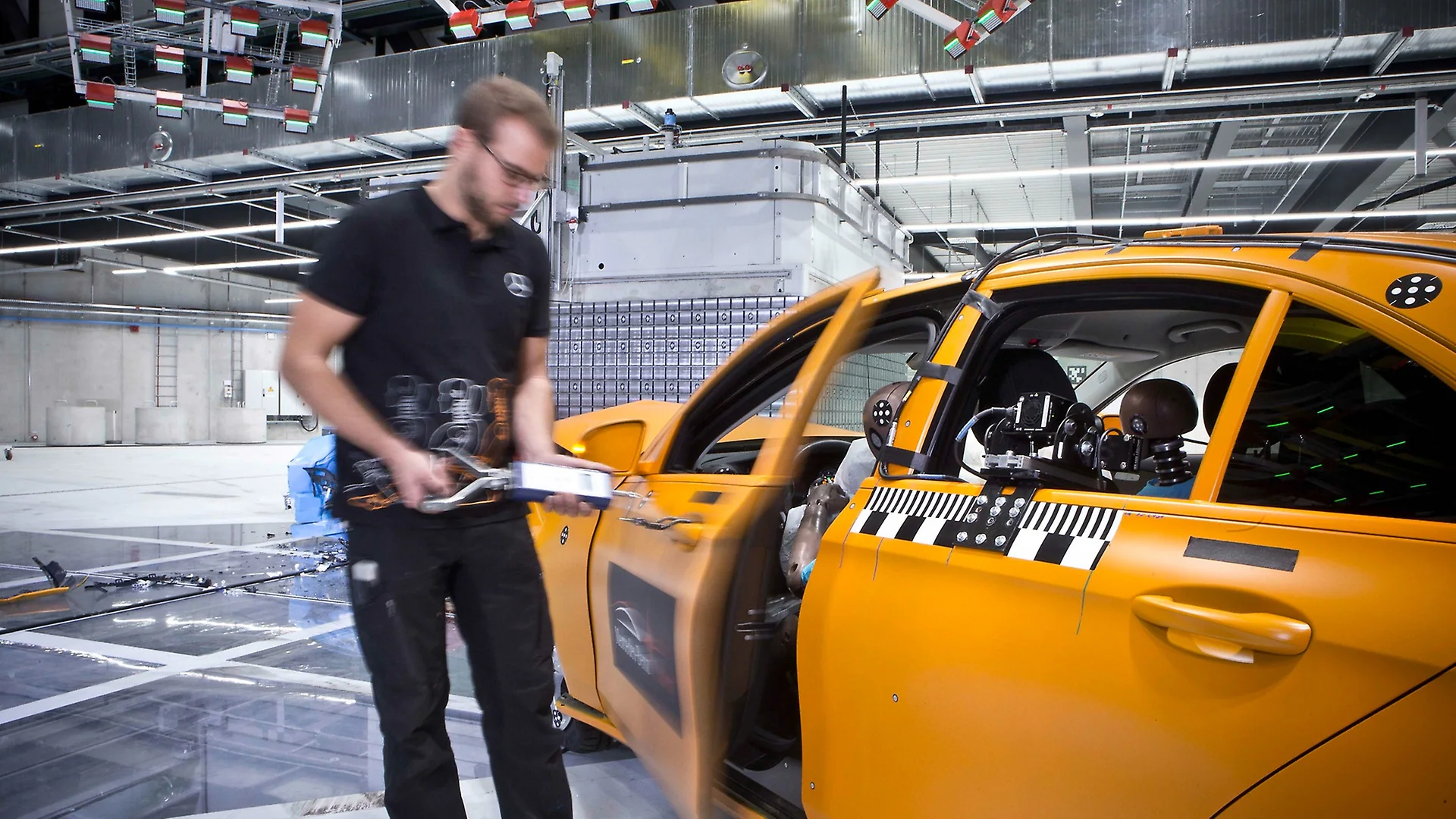
At least one of these test bodyshells for each Mercedes-Benz model series is kept in stock in the high-bay warehouse:
Before every test, the bodyshells are equipped with the interior features to be tested in the workshops located directly below.
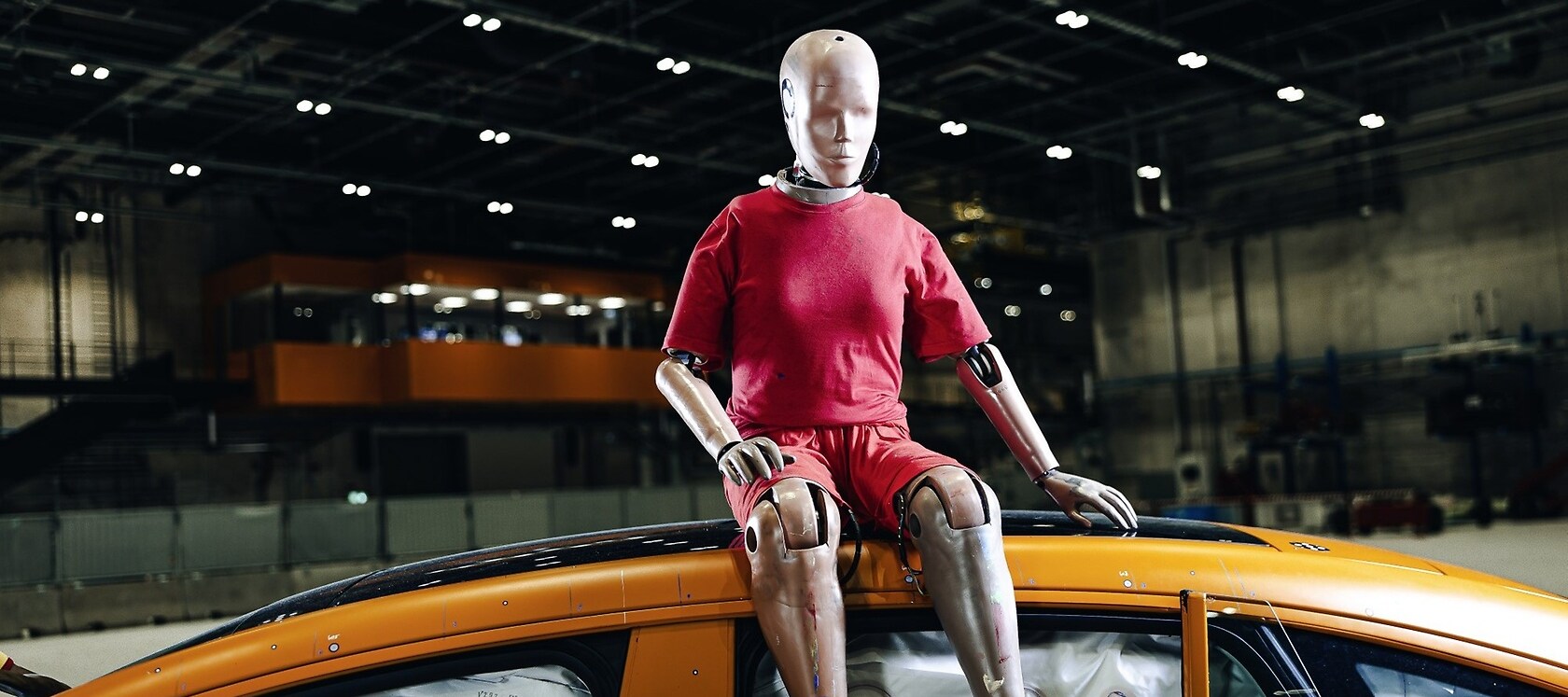
The crash tracks have to be precisely level:
Level crash track surfaces (maximum tolerance 5 mm per 100 m) are important for crash tests with mobile barriers, where lateral impacts are simulated, for example. Apart from their pneumatic tyres, these barriers have no suspension system and might begin to oscillate on a less than completely level surface, falsifying the crash test result. To ensure a completely level surface, the floor slab rests on approx. 500 concrete pillars driven 18 m into the ground.
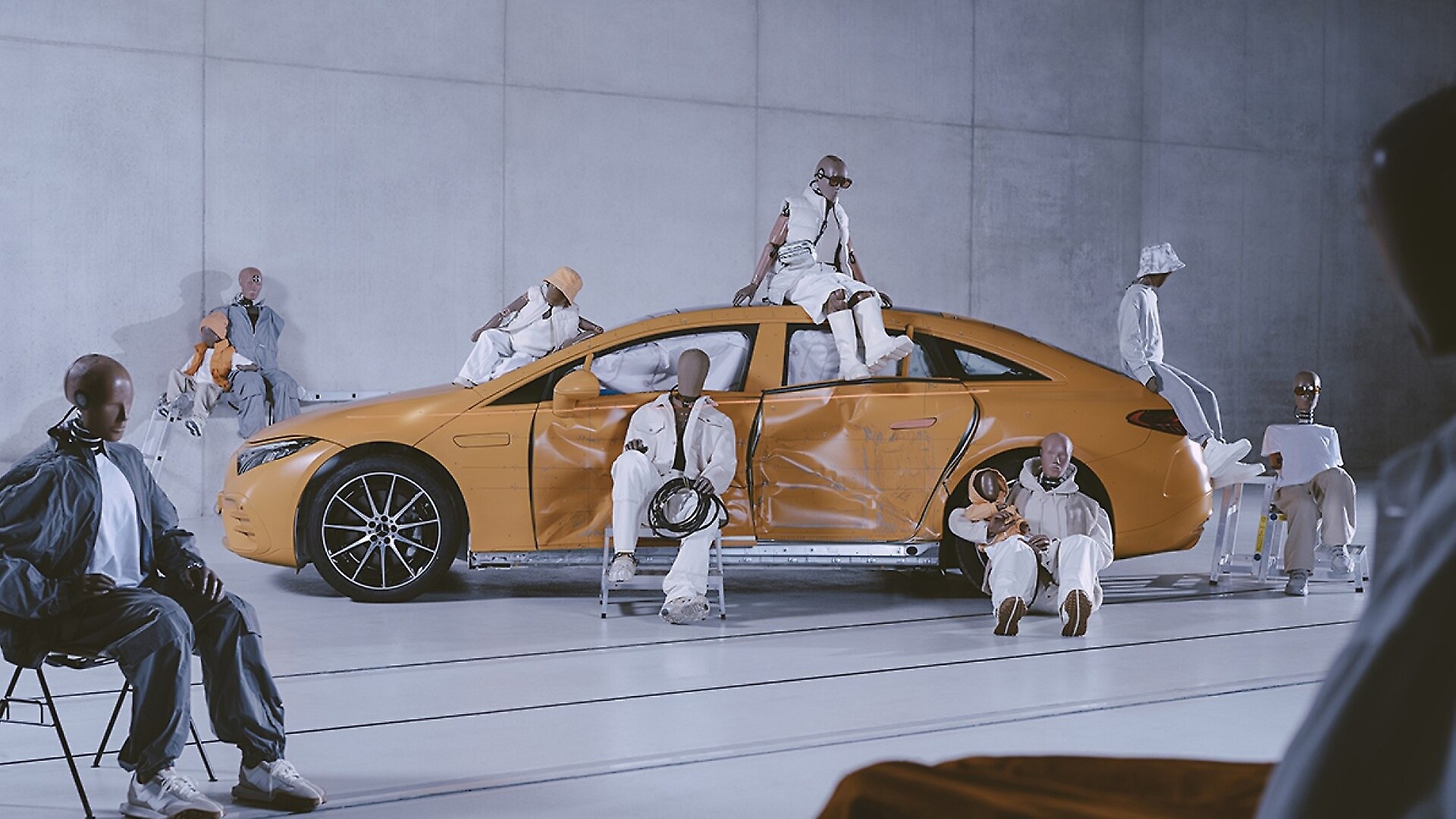
7000 tonnes of steel were installed in the TFS:
The amount of concrete used for the construction is equally impressive: if lined up, all the trucks loaded with concrete for construction of the TFS would form a queue with a length of 40 km.
Two of the five crash blocks have differently configured barriers on each of their four sides:
This means that different crash tests can be configured merely by rotating the block.
Before the crash, the vehicles are accelerated to test speed within just a few seconds:
This is done using steel cables driven by powerful electric motors.
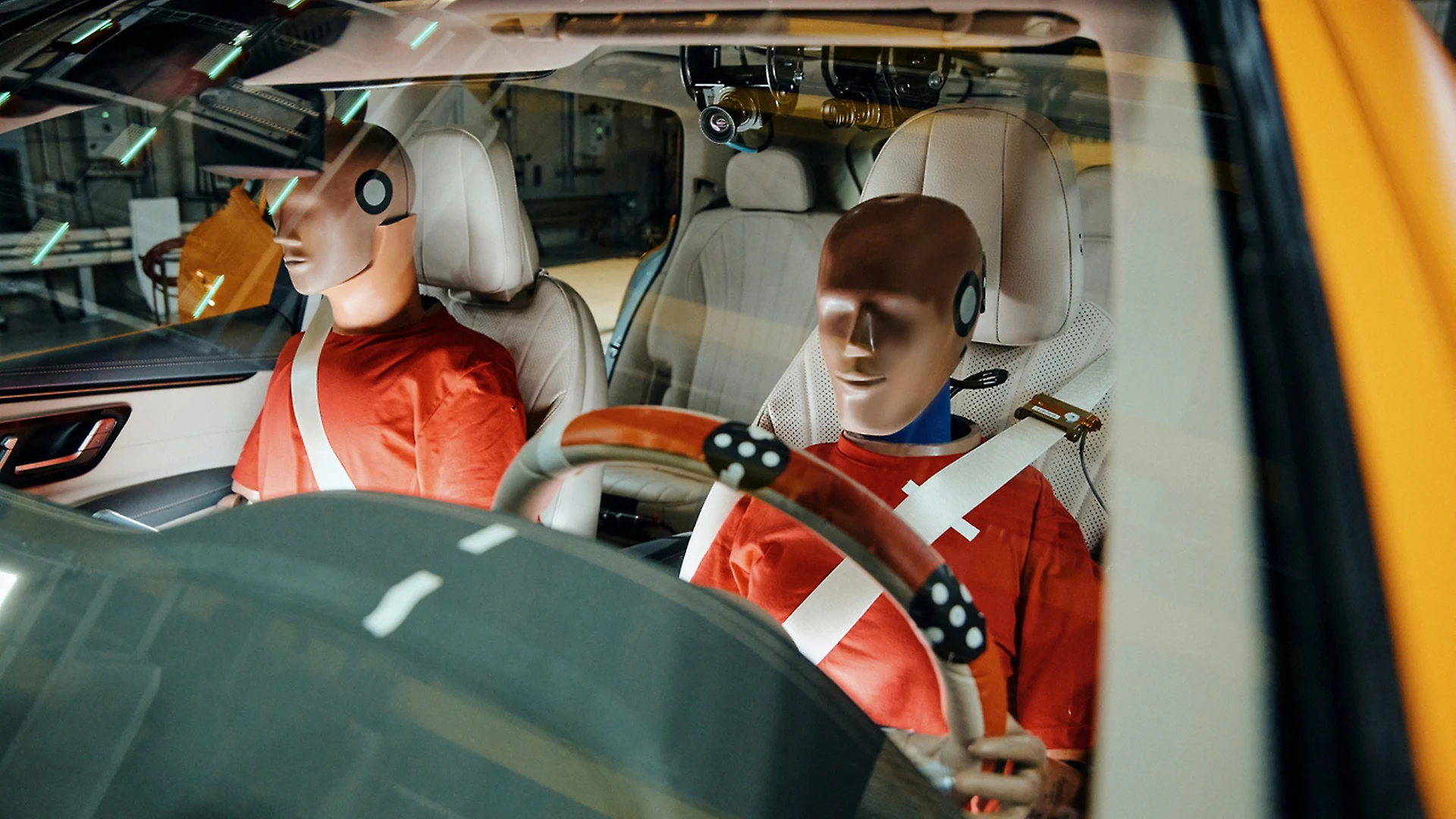
Sled tests are filmed by two camera sleds moving in parallel:
Mercedes-Benz personnel developed this tandem sled procedure for filming sled tests themselves. Previously the camera was mounted on a boom which had to be accelerated and braked along with the sled, reducing the payload of the test sled. In the new system, a tandem sled fitted with cameras on each side moves in parallel with the test sled during the test. The tandem sleds are powered by linear electric motors.
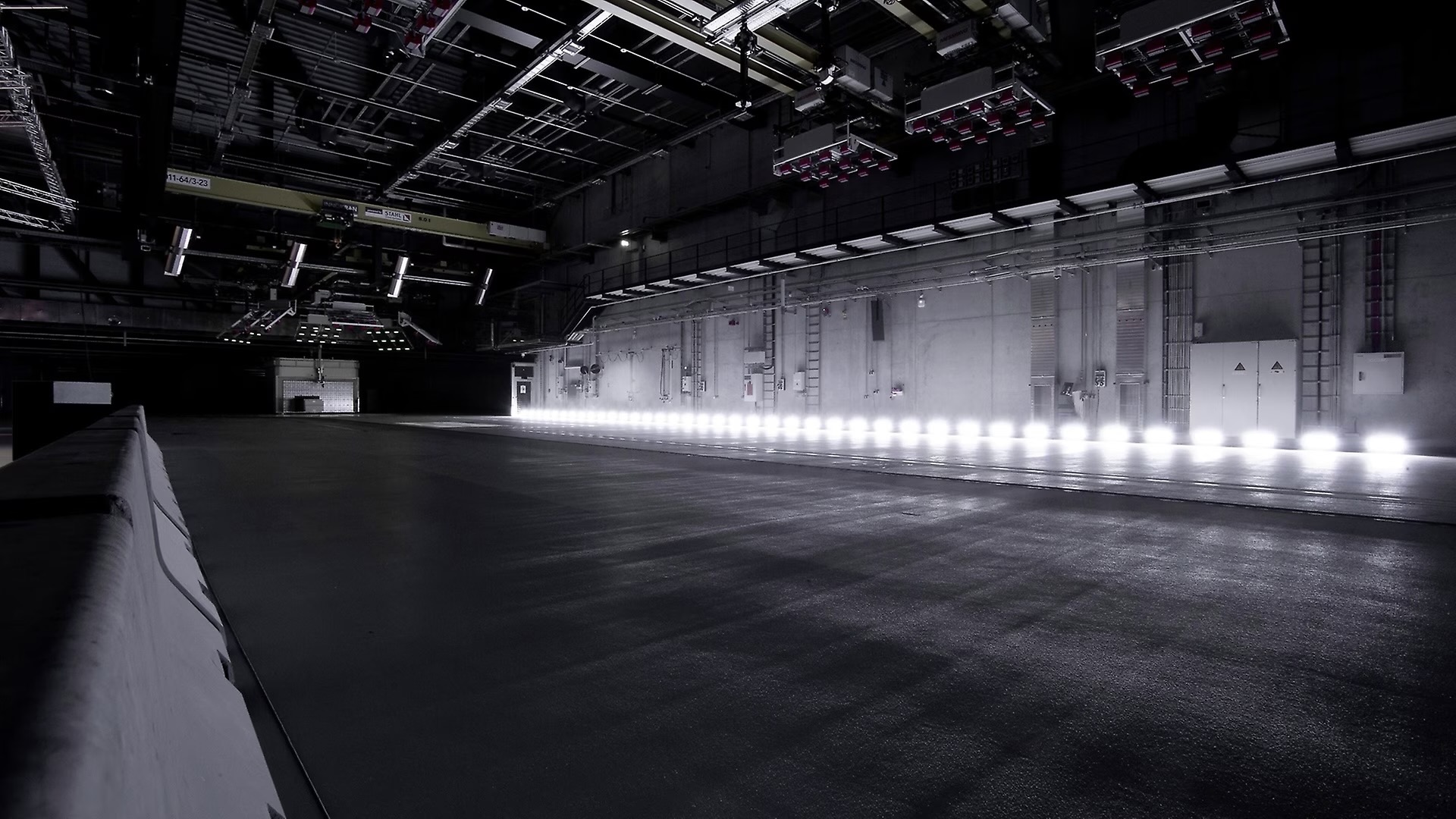
After the crash test and following a fixed procedure, the vehicles are rotated by 360° along their longitudinal axis by a turning mechanism:
This is to check the leak tightness of the fuel tank.
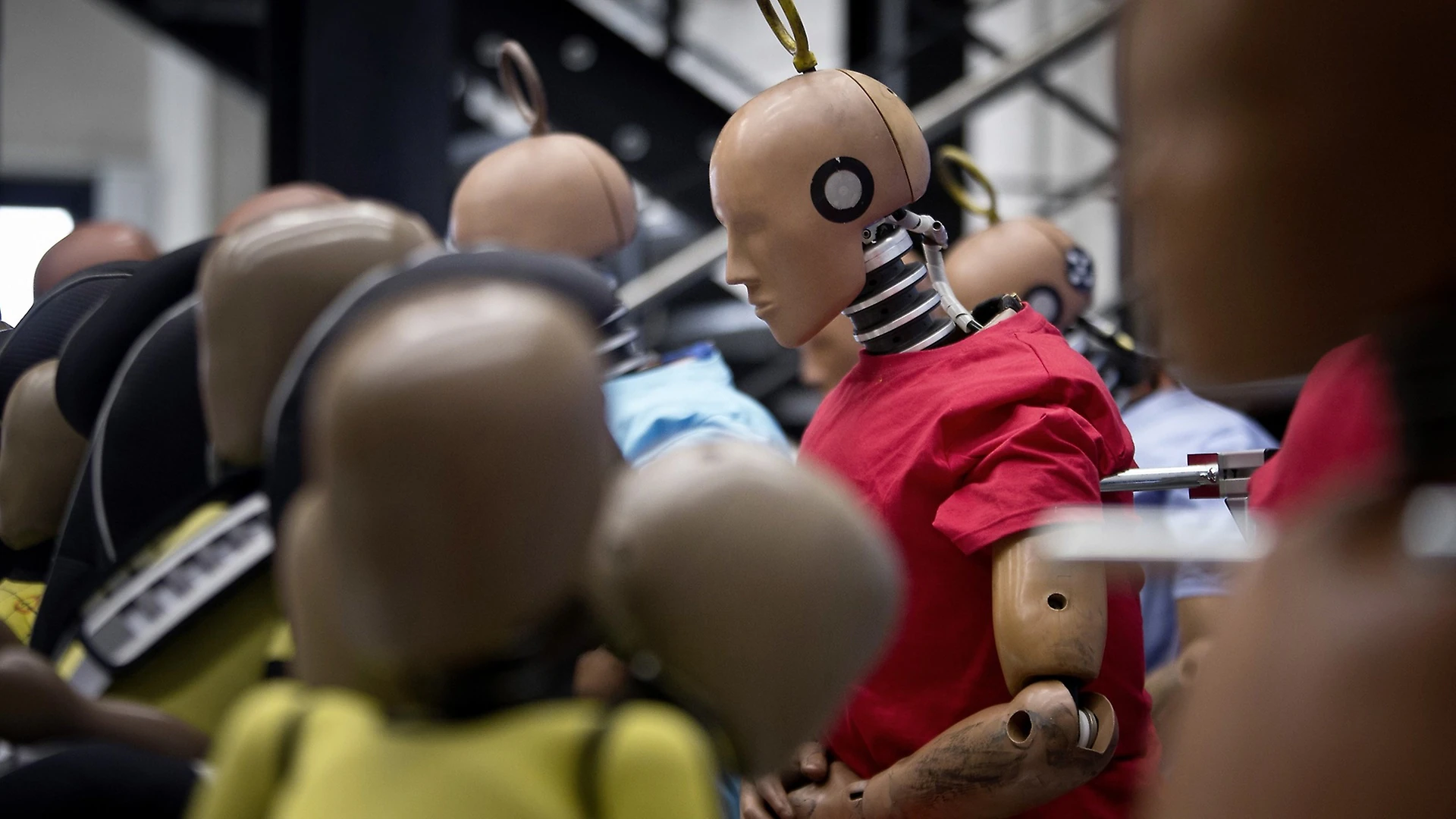
Major test facilities:
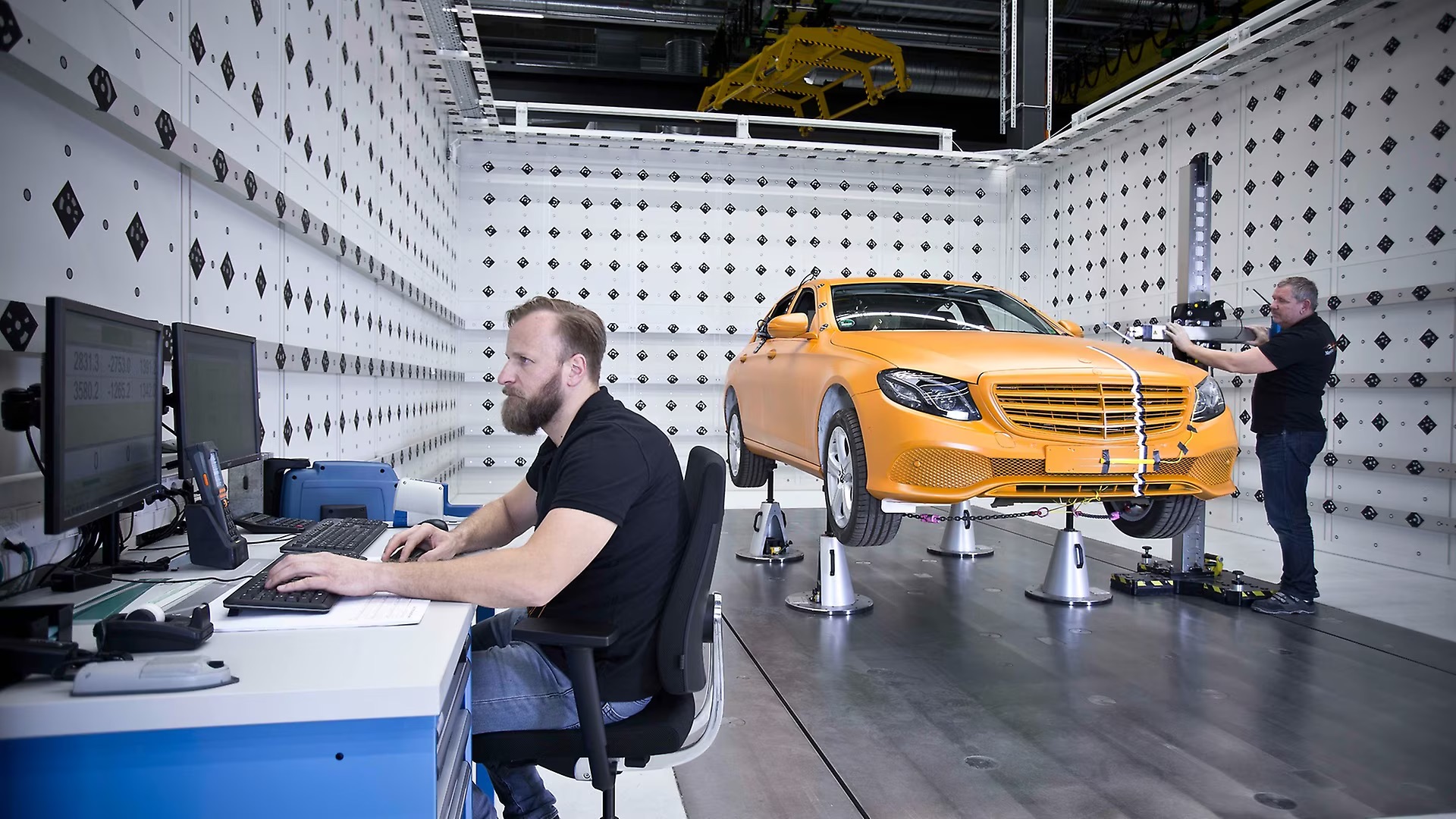
The major test facilities are the interior crash hall with angled tracks and PRE-SAFE® area, the four crash tracks, the sled test area, the gradient/rollover ramp for rollover tests and test stand for head impact tests.
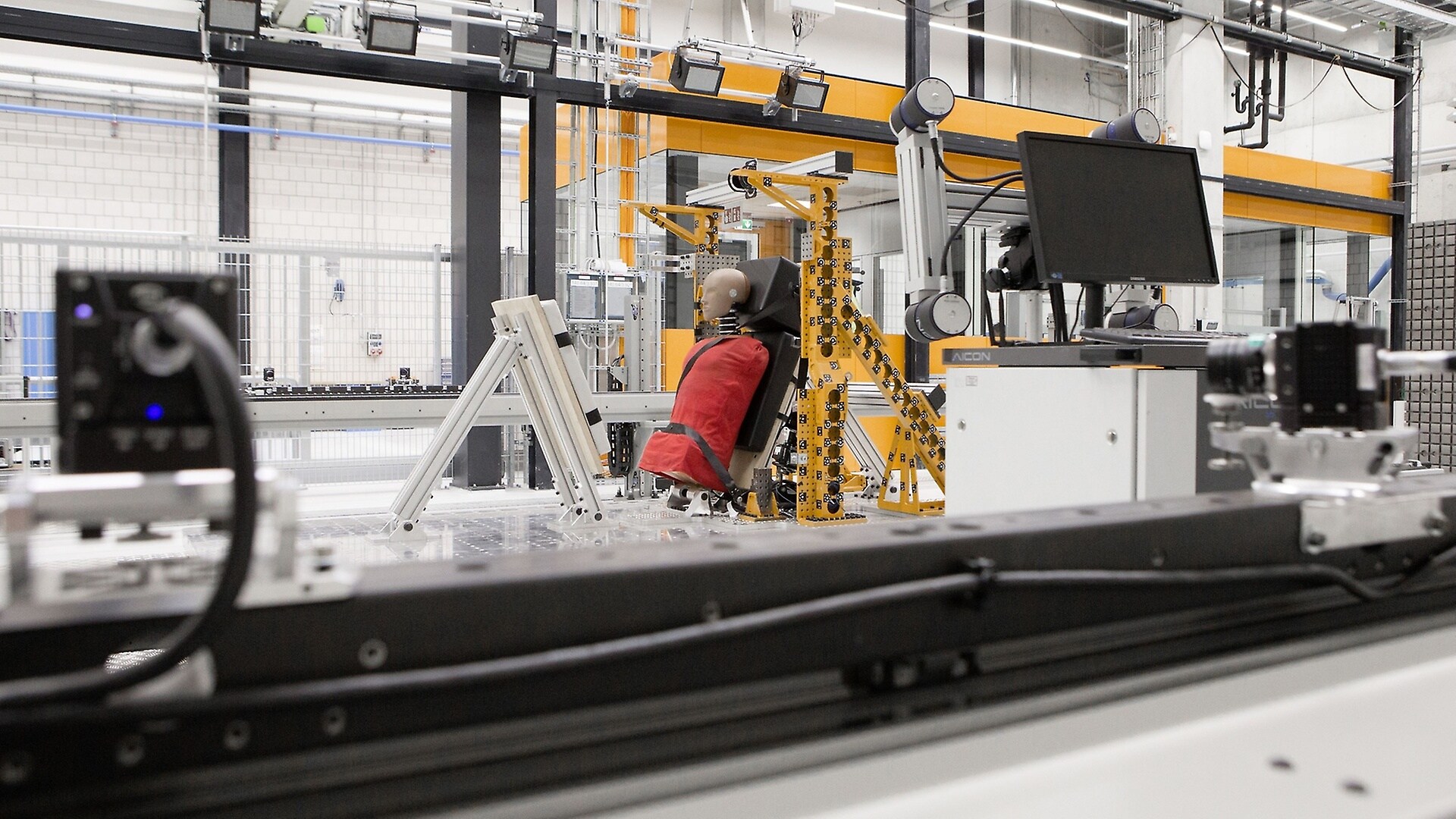
Special features:
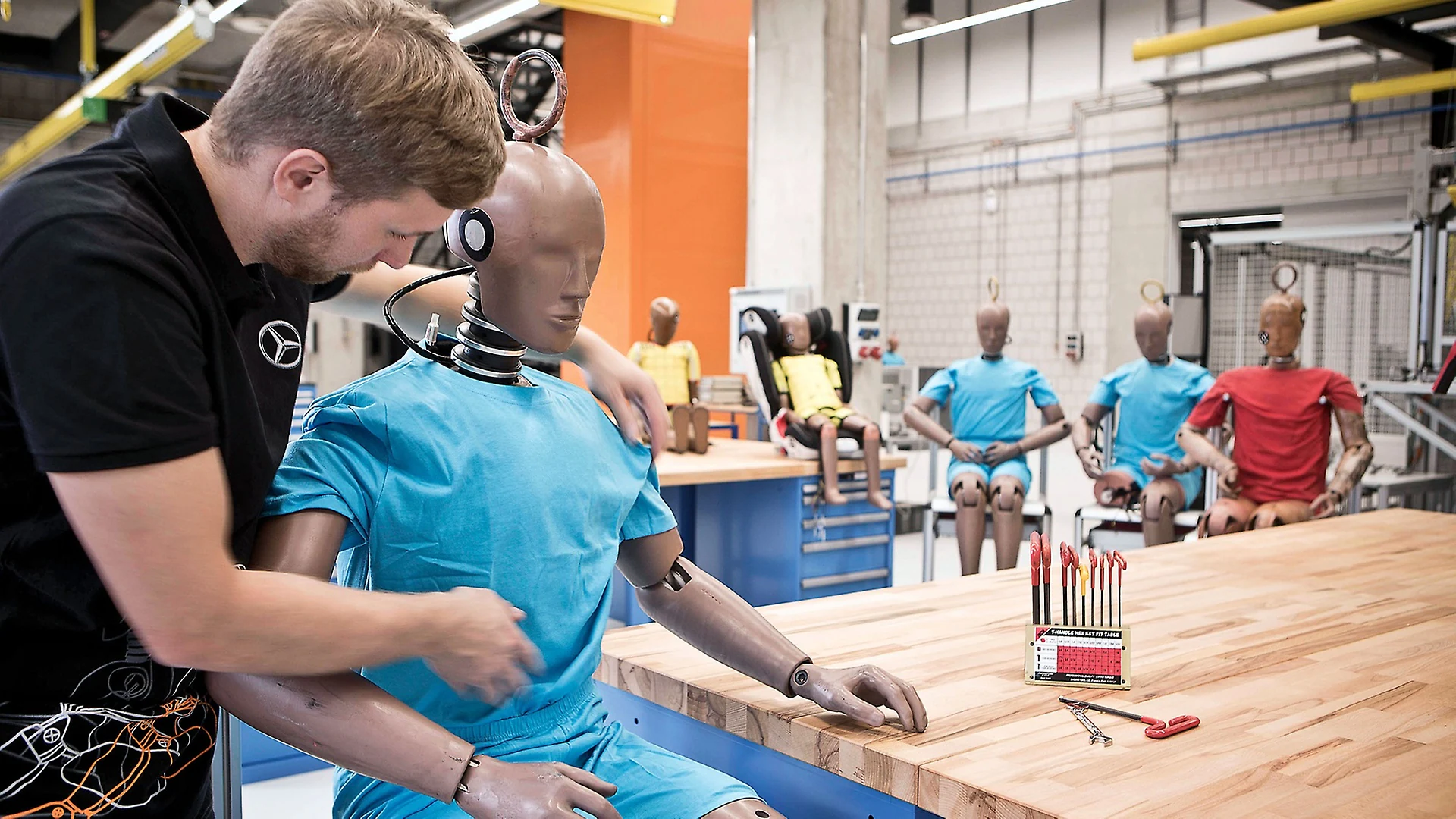
Now crash tests are possible in which the vehicles drive to the obstacle under their own power (also electric and fuel cell vehicles), simulation of real accidents including emergency braking, one rotating and one freely movable crash block plus three stationary blocks, hovercraft for smooth transport of vehicle bodies for sled tests, use of drones for safety monitoring in the crash hall, integrated store for dummies and sled bodyshells, highly precise, automated measuring systems (incl. coordinate measuring system and surface scan).